Eryri (Snowdonia) Myths and Legends
In the depths of Eryri National Park, a land of mighty mountains, of mist and mysticism, of folklore flanked forests and rushing rivers, it’s difficult to imagine a single square mile of land that isn’t steeped in storytelling. Fact or fiction, it hardly seems relevant when these troubled tales of dragons, kings, giants, and fairies have shaped communities and connection to a landscape that is beloved globally.
Rooted in the natural world, these poignant fables are inseparable from the landscape itself, and from
Rhyd y Galen, you can still visit the sweeping sites that hold their stories close, and take them home with you to treasure.
The Red and White Dragon
In the shadow of the hills near Dinas Emrys, the land itself is said to have once trembled with conflict, not of men, but of something far older.
The story tells of a king who sought to build his fortress upon this ground, yet no matter how often the walls were raised, they fell without reason. It was only when a young boy, later known as Merlin, revealed the truth that the mystery began to unfold. Beneath the hill lay a hidden pool, and within it slept two dragons: one red, the other white.
When the earth was opened, the dragons awoke, and their battle shook the very foundations of the land. The red dragon, fierce and unyielding, emerged victorious. It was said to be a sign; a symbol of the struggles yet to come, and of a people who would endure.
Even now, the red dragon remains a powerful emblem of Wales, its origins bound to the hills of Eryri.
The Legend of Gelert
The legend of Beddgelert is not a cheerful one. It documents the tragic tale of the medieval Welsh Prince Llewelyn the Great and his beloved hound Gelert, a faithful companion and friend. On an unfortunate day in the 13th century, the prince abounded on a hunting trip and left Gelert behind, though no stories can quite account for the absence of the hound.
Upon his return, Gelert bounded towards Prince Lleyelyn but his coat was smeared with blood. The Prince ran to his infant son’s cradle, finding it empty. In a fit of despair and rage, he slayed Gelert, plunging his sword into the hound’s side. The resounding howl was answered by the cry of a baby, and, distraught, Lleyelyn found his son’s smiling form beside the body of a wolf which the brave Gelert had slain to protect his master’s kin. The Prince was said to never smile again.
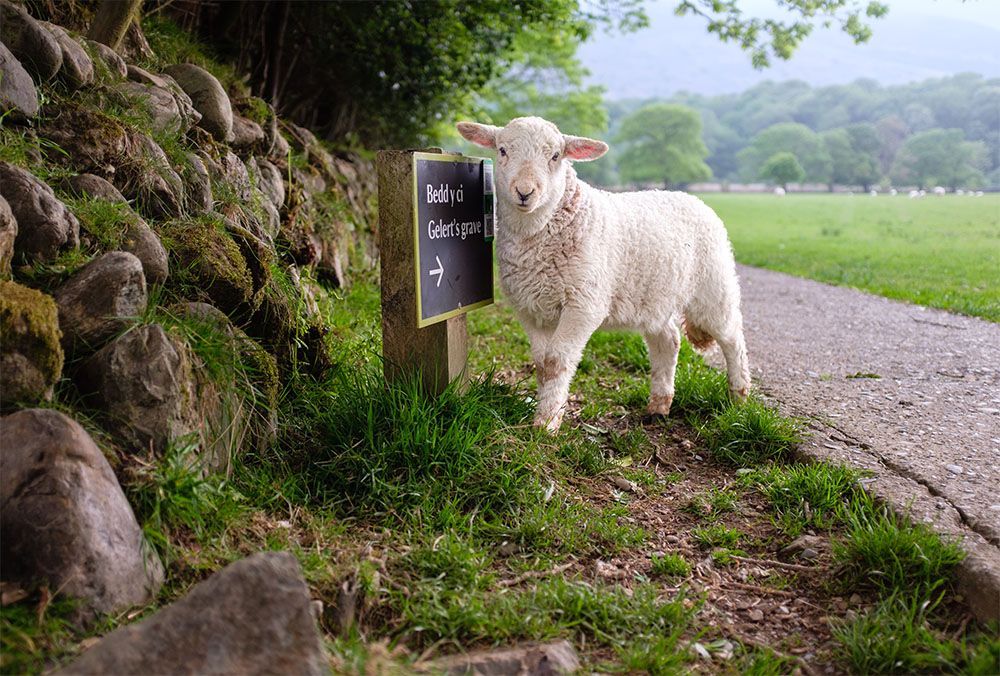
Today, you can visit Gelert’s Grave beside the village of Beddgelert beside the mountains. Although many accounts dispute this site as the final resting place of the noble companion, it is still a well loved spot amongst locals and tourists alike.
The Lady of the Lake
In the still waters of Llyn Ogwen, beneath the watchful presence of Tryfan, lies a story tied to one of the most enduring legends of all.
It is said that this lake was once home to the Lady of the Lake, the mysterious figure who bestowed upon King Arthur his sword, Excalibur. A weapon of legend, it remained with him throughout his life, until the time came for it to be returned. After Arthur’s final battle, the task fell to Sir Bedivere. Standing at the water’s edge, he cast the sword into the lake. From the depths, a hand emerged, catching the blade and drawing it beneath the surface, where it was lost once more to the world above.
Though the tale is disputed and retold in many forms, there is something about Llyn Ogwen that lends itself to belief. Its waters are dark and still, its depths unknowable, just enough to suggest that some stories may yet lie hidden beneath the surface.
The Tale of Bedd y Cawr
Among the rugged reaches of Eryri is the tale of Bedd y Cawr, the “Giant’s Grave,” a site said to mark the resting place of a being far older than memory itself.
Scattered across Britain are burial mounds whose origins were once unknown, their purpose obscured by time. Many came to believe they were the resting places of giants. One such mound lies near Bryneglwys, where a solitary standing stone rises from the remains of the tomb. It is said to mark the grave of a giant warrior, struck down in some long forgotten battle fought in the surrounding fields.
Yet it is not only the giant that lingers in local memory, but the stone itself. In later years, a farmer is said to have taken it, intending to use it as a gatepost. But the land, it seems, did not take kindly to its removal. No matter how firmly it was set, the stone would not stand. Each morning it was found fallen once more, and with it came restless nights and troubling dreams. Only when the stone was returned to its place upon the mound did the disturbances cease, as though something ancient had been set right.
Today, the site remains quiet and easily overlooked. Whether a burial ground or legend shaped by time, Bedd y Cawr stands stoic amongst the mountains.
Yr Wyddfa and Rhitta Gawr
The highest peak in Wales is, itself, legend steeped.
Long before it was known as Yr Wyddfa, the summit was said to be the resting place of Rhitta Gawr, a giant of immense strength and even greater pride. He roamed the land challenging kings, taking from each their beard as a mark of his dominance, stitching them together into a cloak that told of his victories.
But one beard remained beyond his reach, that of King Arthur.
When the challenge was made, Arthur did not yield. Their battle was fierce and final, fought upon the very ground that now rises as the mountain’s peak. In the end, Rhitta fell and stones were piled high over his body, forming the cairn that would become Yr Wyddfa itself.
The Legend of Cantre’r Gwaelod
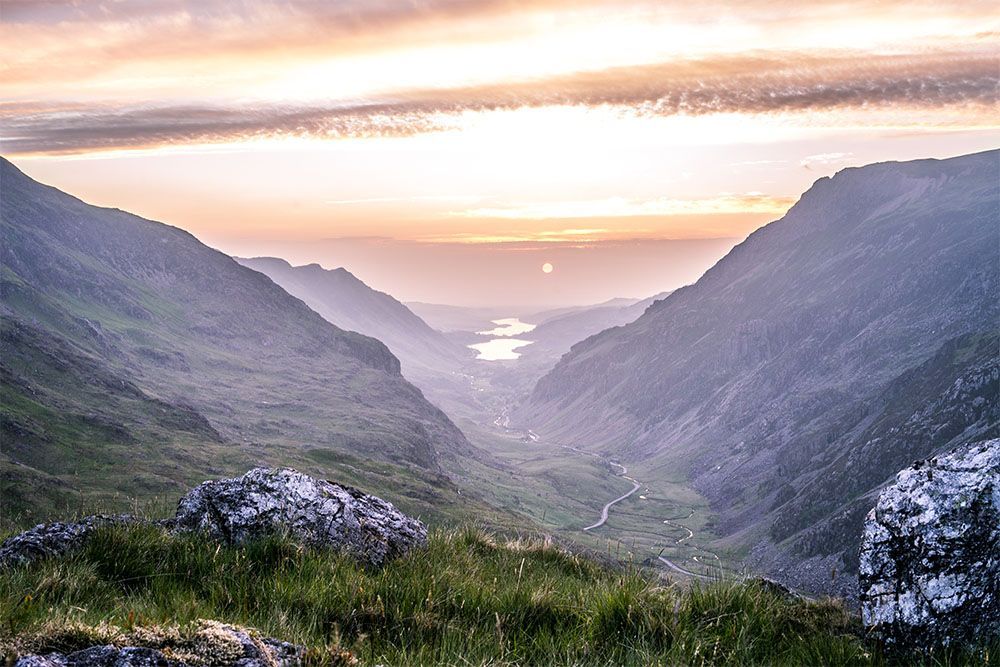
Beyond the mountains, where land meets the restless sea, lies one of Wales’ most haunting legends, that of Cantre’r Gwaelod, a kingdom said to have been swallowed by the waters of Cardigan Bay.
Long ago, in myth alone, this fertile lowland was protected by great sea walls and gates, holding back the tide and allowing its people to prosper. Yet the safety of the realm rested in human hands, and as many tales warn, it takes only a moment of carelessness to undo even the strongest defences.
On a fateful night, the keeper of the gates, whether through neglect, drink, or simple misfortune, failed in his duty. As the tides rose, the sea poured in without restraint, consuming fields, homes, and all that lay in its path.
By morning, the kingdom had vanished beneath the waves.
It is said that, on quiet evenings when the sea lies still, the bells of Cantre’r Gwaelod can still be heard ringing beneath the water.
The Tylwyth Teg
Not all of Eryri’s legends are coated in tragedy. Some are carried on the wind or glimpsed at the edge of sight. Among these are tales of the Tylwyth Teg, the Fair Folk, said to dwell in the hidden places of the Welsh landscape.
The Tylwyth Teg are beings of another realm, bound to the hills, lakes, and hollowed spaces beneath the earth. They are known to favour beauty and music, and to take offence where respect is lacking. Travellers once spoke of hearing distant melodies drifting across the valleys at dusk, or of lights flickering where no fire burned.
Discover the legends for yourself
Nestled amongst the tales that make up the richly fabled Eryri (Snowdonia) lies Rhyd y Galen, the perfect spot to slip off your walking boots and reflect on all that you’ve seen. Our caravan park, campsite and glamping accommodation is a great base for exploring everything North Wales has to offer without removing yourself completely from the experience.
To stay here is to step into our stories, if only for a little while. And, if you’re lucky, you may just experience what many have known to be true for thousands of years; that this land is touched by magic.